
Have you ever wondered why keeping money in a bank feels like it barely grows — but some people seem to get richer just by doing nothing? The secret is compound interest. Once you truly understand it, you will never look at money the same way again.
Albert Einstein reportedly said:
| “Compound interest is the eighth wonder of the world. He who understands it, earns it. He who does not, pays it.” |
In this article, we break down compound interest in the simplest possible way — with real examples, easy numbers, and practical steps you can use today.
What Is Compound Interest?
Let us start with a quick comparison.
Simple interest: You earn interest only on your original amount. That is it.
Compound interest: You earn interest on your principal AND on the interest you already earned. Your interest starts earning more interest. This snowball effect is what makes it powerful.
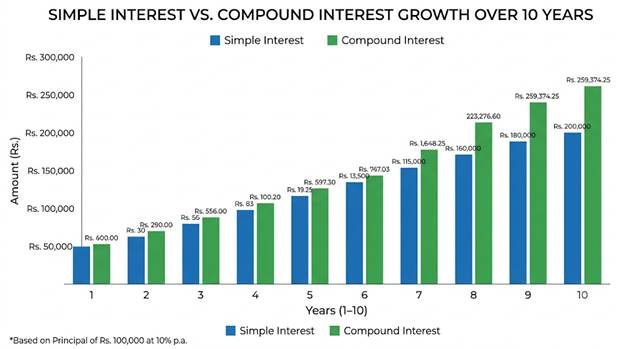
A Real Example With Nepali Numbers
Say you invest NPR 10,000 at 10% interest per year for 10 years.
With simple interest: You earn NPR 1,000 every year. After 10 years, total = NPR 20,000.
With compound interest: Year 1 earns NPR 1,000. Year 2 earns 10% of 11,000 = NPR 1,100. Year 3 earns 10% of 12,100 = NPR 1,210. And it keeps growing. After 10 years, total = NPR 25,937.
That is NPR 5,937 extra — just by letting your interest earn more interest. You did nothing extra.
| The longer you let your money compound, the more dramatic the difference becomes. Starting early is the single most powerful financial decision you can make. |
For self calculation of compound interest: compound interest calculator
How Often Does Compounding Happen?
Compounding can happen at different speeds — and faster compounding means faster growth:
- Annual: interest added once per year
- Quarterly: interest added 4 times per year
- Monthly: interest added 12 times per year
- Daily: interest added 365 times per year
Most Nepali banks compound monthly or quarterly on savings and fixed deposits. Always ask your bank how frequently they compound. A 10% rate compounded monthly gives an effective annual return of about 10.47%.
The Rule of 72 — A Quick Mental Trick
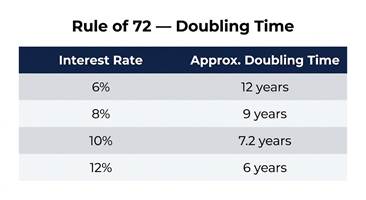
Want to estimate how long it takes to double your money? Use the Rule of 72. Divide 72 by your interest rate and you get the approximate years.
| Rule of 72 Examples: At 6% interest: 72 / 6 = 12 years to double At 9% interest: 72 / 9 = 8 years to double At 12% interest: 72 / 12 = 6 years to double |
This is a rough estimate but accurate enough for everyday planning — and very useful for quick thinking.
Where Does Compound Interest Work in Real Life?
It works for you when you save and invest. It works against you when you borrow.
Where it HELPS you:
- Fixed deposits at Nabil Bank, Nepal Investment Bank, NIC Asia
- Mutual funds on NEPSE — reinvested dividends compound over time
- Employees Provident Fund (EPF) — annual compounding builds retirement savings
- Share investments — dividend reinvestment accelerates growth
Where it HURTS you:
- Credit card debt — unpaid balance compounds at 18-24% per year
- Personal loans — missing payments leads to interest on interest
- EMI schemes — total paid is often far more than the original price
3 Simple Steps to Start Using Compound Interest Today
You do not need a lot of money. You need time and consistency.
- Start early: NPR 2,000 per month from age 22 grows far more than NPR 10,000 per month started at age 35
- Reinvest returns: Never withdraw interest or dividends — let them compound
- Increase slowly: As your income grows, increase savings even by small amounts
The single most important action is to start today. Even NPR 500 per month, started now, beats NPR 5,000 per month started 10 years from now.
[INTERNAL LINK] Link how to start investing to your beginner investing guide on finomicswithsandip.xyz
Key Takeaways
| Compound interest = earning interest on your interest More time = dramatically more money — start early Compounding HELPS you in savings and investments Compounding HURTS you in loans and credit cards Rule of 72: divide 72 by interest rate = years to double your money |
Final Thoughts
Compound interest is one of the most powerful forces in personal finance — and it is available to everyone. The only difference between someone who benefits from it and someone who does not is knowledge and the decision to start early.
Whether you open a fixed deposit, invest in a mutual fund, or simply stop withdrawing your savings interest — you are putting compound interest to work.
For more simple guides on money and investing in Nepal, visit finomicswithsandip.xyz. Share this with someone who needs it.